Showing posts with label Mechanics. Show all posts

Thursday, 11 April 2024

Outlaws of Thunder Junction - New Mechanics

This weekend is prerelease weekend, the first chance for players to get their hands on the new MTG set 'Outlaws of Thuder Junction'. So with this in mind I thought it was time to look at the new mechanics...

OUTLAWS

Success on this plane, and on other planes I suppose, often boils down to the company you keep. Several cards in the set refer to outlaws.


An outlaw, used as a noun, is any permanent with one or more of these creature types: Assassin, Mercenary, Pirate, Rogue, and Warlock. You'll often see abilities such as the one Rakish Crew has that refer to "an outlaw you control." This phrase refers only to permanents on the battlefield, not spells or cards anywhere else. Outlaws are almost always creatures, but a kindred permanent (a little-seen card type previously known as tribal) with one or more of the right creature types can also be an outlaw. Go figure.

Outlaw can also be used as an adjective to describe something else, such as a spell or a card in a zone other than the battlefield. For example, an ability may trigger whenever you cast an outlaw spell or return an outlaw creature card from your graveyard to the battlefield.

COMMITTING A CRIME

Success on this plane, and on other planes I suppose, often boils down to how far you're willing to go to get what you want. The new rules term committing a crime covers a range of common actions you'll probably be happy to take during your games. Several cards in the set will even reward you for doing so.


You commit a crime as you cast a spell, activate an ability, or put a triggered ability on the stack that targets one or more of the following:
  • An opponent
  • A spell or ability an opponent controls
  • A permanent an opponent controls
  • A card in an opponent's graveyard
If a spell or ability doesn't target anything on that list, it's not a crime, even if it targets something like an opponent's card in exile or has a sinister-sounding name that would be a felony in many jurisdictions.

Once you cast the spell, activate the ability, or put the triggered ability on the stack, the crime has been committed. It doesn't matter what happens to the spell or ability (or any of its targets) after that point.

SPREE

Success on this plane, and on other planes I suppose, often boils down to not settling when you can have it all. Spree is a new keyword found on several modal cards in this set.


Each mode includes an additional cost that must be paid to cast the spell. You must choose one or more modes as you cast a spell with spree, but no single mode can be chosen more than once. If you cast a spell with spree without paying its mana cost, you must still choose one or more modes and pay those additional costs. The mana cost is covered though, so at least you enjoy a nice discount.

Spree cards have a modified frame that includes a plus sign by the mana cost—this is just a reminder and has no actual rules meaning. Remember that no matter which modes you choose and which additional costs you pay, the mana value of a spell with spree is based only on its mana cost. For example, Final Showdown's mana value is always 1, even if you chose all three modes.

MOUNTS AND SADDLE

Success on this plane, and on other planes I suppose, often boils down to not standing still for too long. Find yourself a trusty Mount and saddle up. Thunder Junction, let's ride!


Mount is a new creature type. It doesn't have any specific rules associated with it; it's just where you're most likely to find the new ability saddle. There's no real connection between Mounts and saddle other than a flavorful one. If a Mount becomes some other creature type, it will still have saddle, and non-Mounts can gain saddle if effects allow them to do so.

Saddle is an activated ability that you activate as a sorcery—meaning during your main phase while the stack is empty—by tapping any number of untapped creatures you control other than the Mount with saddle with total power N or more, where N is the number included in the saddle keyword.

As the saddle ability resolves, the Mount becomes saddled until end of turn. This doesn't inherently mean anything, but another ability on the card will somehow refer to the Mount being saddled. Many Mounts have simple triggered abilities like the one Trained Arynx has—these trigger whenever the Mount attacks while saddled. But some Mounts give you a little more bang for your bucking bronco. Our old friend The Gitrog doesn't treat its riders too kindly, but you'll be in prime position to benefit.

PLOT

Success on this plane, and on other planes I suppose, often boils down to planning. Plot is a new keyword that allows you to pay a cost up front and exile a card from your hand. The card then becomes plotted. On a future turn, you may cast a plotted card from exile without paying its mana cost. Both the special action to plot the card from your hand and casting a plotted card from exile are done as a sorcery—again, meaning during your main phase while the stack is empty.


Plot is a fantastic way to set up future turns, knowing that your spell is available for no further mana investment. To take full advantage of Plan the Heist, you'd prefer to have an empty hand as it resolves. Or maybe you're still searching for a second source of blue mana. No matter your reasons, plotting the card sets you up for a potent turn in the future.

Some plot cards offer cheaper plot costs, letting you save on mana if you're willing to wait for a future turn to finally cast the spell. Some are creatures with triggered abilities that you may want to time more strategically. What's more, the plot keyword isn't the only way to have cards become plotted. 

The same timing rules apply to any card that becomes plotted, no matter how that happens. It can't be cast on the same turn it became plotted. When you finally do cast the spell, you do so as a sorcery.

BOUNTIES (COMMANDER MINIGAME)

Success on this plane, and on other planes I suppose, often boils down to keeping your eyes on the prize. Bounty cards are a special addition to Commander decks that present players with some interesting characters to try and apprehend.

If your game includes bounties, all players use a shared bounty deck, which consists of at least 6 of the 12 total bounty cards. The bounty deck uses no more than one of any particular bounty card. After all, once they're caught, no sense in putting out another bounty on them, right? That's just throwing away good loot.

Bounties begin on the starting player's third turn. Gives the fugitives a sporting chance, you know? Each bounty card describes the condition under which a player may capture them and claim their reward. Only the player whose turn it is can claim a reward, and only one reward may be claimed per turn.

There are four different reward levels for bounties, and each bounty uses the same reward chart. If you claim a reward on the turn that bounty was first offered, you create a Treasure token—the level 1 reward. If a bounty goes unclaimed at the end of the turn, the reward level increases until the maximum reward is offered at level 4, two Treasure tokens and a card.

Once you claim a reward, set that bounty card aside. You can place it next to you for bragging rights. As the next turn begins, you'll reveal who's next to be on the run. If the bounty deck is depleted, there's been a jailbreak! Shuffle all the bounty cards back together to reform the bounty deck. You'll have to get to work catching everyone again. At least there's more Treasure and maybe some cards in it for you.




Tuesday, 2 January 2018

Ascend

Rivals of Ixalan features one new keyword: ascend. Ascend unlocks different bonuses on different cards if you have the city's blessing. That's a fairly unusual description for a Magic ability, but then again, ascend is a fairly unusual ability. 

What is the city's blessing? How do you get it? Let's have a look at a couple of new cards.


The city's blessing is a designation that the ascend ability can give you. The city's blessing isn't a permanent or emblem, and nothing can destroy it or otherwise interact with it. It's just something true about you. It doesn't do anything by itself, but different cards will get bonuses if you have the city's blessing. For example, Dusk Charger gets a nice boost to 5/5 if you have the city's blessing.

If ascend is on a permanent, it constantly checks to see whether you control ten or more permanents. 

The moment you do, you get the city's blessing. This doesn't use the stack and can't be responded to. It just happens. But the permanent with ascend has to be under your control to check. If you control ten permanents, then go back to eight, and then you cast Dusk Charger as your ninth permanent, you won't get the city's blessing just yet. Ascend always looks at the current game state, not the past.

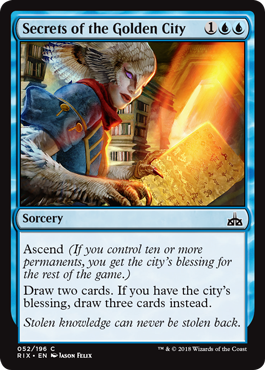
Ascend also appears on instants and sorceries, such as Secrets of the Golden City.

The ascend ability on an instant or sorcery works slightly differently. In this case, the ascend ability checks if you control ten or more permanents only once, as the spell resolves. Spells with ascend also do other things. Those instructions appear after the ascend ability, so they'll happen after the check. 

This means Secrets of the Golden City can give you the city's blessing before determining whether you'll draw two or three cards.

When checking if you control ten or more permanents, count every permanent you control, including lands and tokens. Don't forget Auras and Equipment, even if they are somehow attached to permanents you don't control. Don't count counters, though, as they aren't permanents.

Once you have the city's blessing, you keep it for the rest of the game. Nothing can take it away from you. If you lose all your permanents after gaining the city's blessing, well that sucks and you're probably going to lose, but you'll keep the city's blessing! For example, if you control eight permanents but have previously received the city's blessing, you'll draw three cards as Secrets of the Golden City resolves.

Multiple players can all have the city's blessing at the same time. With all the warring factions on Ixalan, the Immortal Sun hops around like a hot potato, but possessing it even briefly leaves you forever changed. Gaining the city's blessing doesn't impact any other player's current blessing status.

Although the city's blessing isn't a permanent, token, or emblem, there is a a printed card to use as a reminder. 

Tuesday, 4 July 2017

Hour of Devastation - Eternalize

With the prerelease events happening this weekend, lets have a quick look at Eternalize..

Mummies were an accepted part of everyday life in the city of Naktamun. The last set's embalm ability gave your creatures a second life, as it were. The new ability eternalize is similar. Creatures with eternalize can be reborn as Zombies. But we're not talking about simple mindless servants this time around. These are Bolas's Eternals: a lethal undead fighting force that has transcended their mortal capabilities.


Like embalm, eternalize is an activated ability you can activate if the creature card with eternalize is in your graveyard. To do this, pay the eternalize cost and exile the card with eternalize from your graveyard. You can do this any time you could cast a sorcery, which means during your main phase when nothing else is happening. Just like with embalm, the eternalize ability isn't casting a spell. Things that counter spells won't work against eternalize.

When the ability resolves, you create a token copy of the card. As you'd expect, the process of becoming a champion of a millennia-old, power-obsessed, thoroughly evil Dragon Planeswalker causes some rather pleasant changes. The Eternals are very much undead, so they'll be Zombies in addition to whatever creature types it used to have. They're focused on serving Nicol Bolas and him alone, so they'll be black instead of their former colors. They'll also lose their mana costs, just like creatures with embalm did.

Here's the best part: the token will be 4/4 instead of its printed (and smaller) power and toughness. Many creatures with eternalize have abilities that get better because of their increased power. Even if your opponent manages to deal with your eternalize creature once, it'll be much worse for them the second time around.

Remember those sweet printed tokens that were made to highlight the new Zombie look of embalmed creatures? If you're thinking they should do that for eternalize, I have great news: They did. Each creature with eternalize has a corresponding token.


These tokens are optional play accessories. If you don't have the right token or if you just don't want to use them, you don't have to. But if you prefer your victory to be decorated with the lazotep-coated instruments of your ascendance, you have the opportunity.

This video may also be of help...

Monday, 19 June 2017

MTG - New Mechanics

With the prerelease for the new set of MTG only a short while away it is time to have a look at some of the new mechanics.

First up we have AFFLICT  ...

The God-Pharaoh's legions are destructive, vicious, and just generally the sorts of folks you wouldn't invite to a party. But perhaps you're just going to the wrong parties. In any case, if a minion of Bolas is attacking you, it's a sure bet something bad is going to happen. The new ability afflict ensures just that.

Khenra Eternal attacking puts your opponent in an uncomfortable position. If they don't block it, it gets through to deal combat damage. If they do block it, they're losing 1 life anyway. Different creatures with afflict have different afflict numbers and cause the loss of different amounts of life. It doesn't matter how many creatures block a creature with afflict; afflict triggers only once per combat at most.

Tuesday, 3 March 2015

Dragons of Tarkir Mechanics

With the new MTG set only a few of weeks away here is a breakdown of the mechanics we can expect...

BOLSTER
Bolster is the signature ability of the green-white Dromoka clan. It hasn't changed since its appearance in Fate Reforged.


To bolster, first find the creature you control with the least toughness. If there's a tie, choose one of those creatures. Then put a number of +1/+1 counters on that creature equal to the bolster number. Bolster doesn't target any creature. You don't determine which creature is getting the counters until you're taking the bolster action.

So suppose you control a 2/2 creature and a 1/1 creature and you cast Sandcrafter Mage. When Sandcrafter Mage enters the battlefield, its ability triggers. In response to that ability, your opponent destroys your 1/1 creature. When Sandcrafter Mage's triggered ability resolves, you control two 2/2 creatures. Since both of these creatures are tied for the least toughness, you choose one of them. It gets a +1/+1 counter, and you have a shiny new 3/3 creature.


REBOUND

Rebound is the signature ability of the white-blue Ojutai clan. Rebound is making its return (you all saw this coming, right?) after originally appearing in the Rise of the Eldrazi set. How it works hasn't changed.


Rebound lets you cast an instant or sorcery spell a second time for free. If you cast a spell with rebound from your hand, you exile it instead of putting it into your graveyard. Then, at the beginning of your next upkeep, you can cast the spell again without paying its mana cost. After casting it from exile, it's put into your graveyard. If you manage to have several spells rebound during the same upkeep, you can cast those spells in any order.

If you have any creatures from the last two sets with prowess, casting a spell with rebound will give you two bonuses, once for each time you cast the spell. (Prowess doesn't appear in Dragons of Tarkir.)

Rebound works only if the spell resolves. If it's countered for any reason, either because your opponent casts a spell like Negate or because all of the spell's targets became illegal, it won't rebound. It will just be put into your graveyard with no effect. If you can't cast the spell from exile, perhaps because it requires a target and none are available at that time, then the spell just stays in exile.


EXPLOIT

Exploit is the signature ability of the blue-black Silumgar clan. When a creature with exploit enters the battlefield, you may sacrifice a creature you control.


But you're not just sacrificing your loyal minions for fun. Each creature with exploit has another ability that gives you a benefit when it "exploits a creature." This means when you sacrifice a creature because of its exploit ability. That ability doesn't trigger if you sacrifice a creature for any other reason, including the exploit ability of a different creature.

You can sacrifice any creature you control when the exploit ability resolves, including the creature with exploit itself. You don't have to sacrifice a creature if you don't want to. If you do, you choose which one as the exploit ability resolves. To get the most out of your minions, look for creatures with abilities that give you an added benefit when they die.


DASH

Dash is the signature mechanic of the black-red Kolaghan clan. Dash allows your creatures to strike and disappear before your opponent knows what's happened. It hasn't changed since its appearance in Fate Reforged.


Dash is an alternative cost found on creature spells. As you cast a spell with dash, you can pay its dash cost instead of paying its mana cost. If you do, the creature will have haste, so it can attack that turn. At the beginning of the next end step, you'll return the creature from the battlefield to its owner's hand.
If you choose to pay the dash cost, you're still casting the spell, so it goes on the stack and can be countered. Dash doesn't change when you can cast creature spells, usually only during your main phase. If you cast a creature spell using its dash cost, it will return to your hand only if it's still on the battlefield at the beginning of the next end step. If it leaves the battlefield before that point, it'll just stay wherever it is.

Some dash costs are lower than the mana costs of the creature cards they're on. So, if you have four mana available you can cast Sprinting Warbrute a bit earlier than you otherwise could and get an extra attack in. On the next turn, you can cast it for its mana cost and it'll stay on the battlefield like normal. Other cards have dash costs that are the same or higher than their mana costs. Attacking with such a creature right away can be powerful, so you may want to cast such a creature using it dash cost even if you could pay its mana cost.


FORMIDABLE

Formidable is the signature mechanic of the red-green Atarka clan. Formidable is an ability word, so every formidable ability is different, but they all care in some way about controlling creatures with total power 8 or greater. Read each one carefully to see exactly what it does.


When calculating the total power of creatures you control, use their actual powers, even if they're less than 0. For example, say you control creatures that are 0/3, 4/4, and 8/8. The total power of creatures you control is 12. But if your opponent cast a spell that gave the 4/4 creature -6/-0, you'd have an 0/3, a -2/4 and an 8/8. Their total power is 6.

Stampeding Elk Herd's ability has an "intervening 'if'" clause, which is basically a condition of a triggered ability sandwiched in the middle. Abilities like this check the condition two times: once when the ability would trigger. If you don't control creatures with total power 8 or greater at that time, the ability doesn't even trigger. If the ability does trigger, it checks whether you still control creatures with power 8 or greater to see if it resolves. If you don't, the ability does nothing.

Other formidable abilities are activated abilities. You must control creatures with total power 8 or greater in order to activate them. However, once you activate such an ability, it doesn't matter what happens to your creatures. Even if their total power dips below 8, the activated ability will be unaffected.


MEGAMORPH

Think of everything you loved about the morph ability from Khans of Tarkir. Megamorph is all of that, but bigger!


If you understand how morph works, megamorph is almost exactly the same. The only difference is that if you turn a face-down creature with megamorph face up by paying its megamorph cost, not only will it suddenly have its normal characteristics, but you'll put a +1/+1 counter on it as well! Note that if you turn a face-down creature face up some other way (for example, say you manifest a card with megamorph and turn it face up by paying its mana cost), it doesn’t get the counter.

Turning a creature face-up doesn't use the stack and it can't be responded to. So if I controlled a face-down Aerie Bowmasters and turned it face up, it would be a 4/5 (3/4 with the +1/+1 counter) before any player could do anything.

The morph overlay returns in Dragons of Tarkir booster packs to place on face-down creatures with megamorph. It's not necessary to distinguish between creatures you cast face down (although distinguishing between them and manifested cards is still required). This accessory is optional. You don’t have to use them, but look how cool they make your face-down creatures look! They're also a good way to remember to show your opponent what your face-down creature was if it leaves the battlefield or the game ends.